

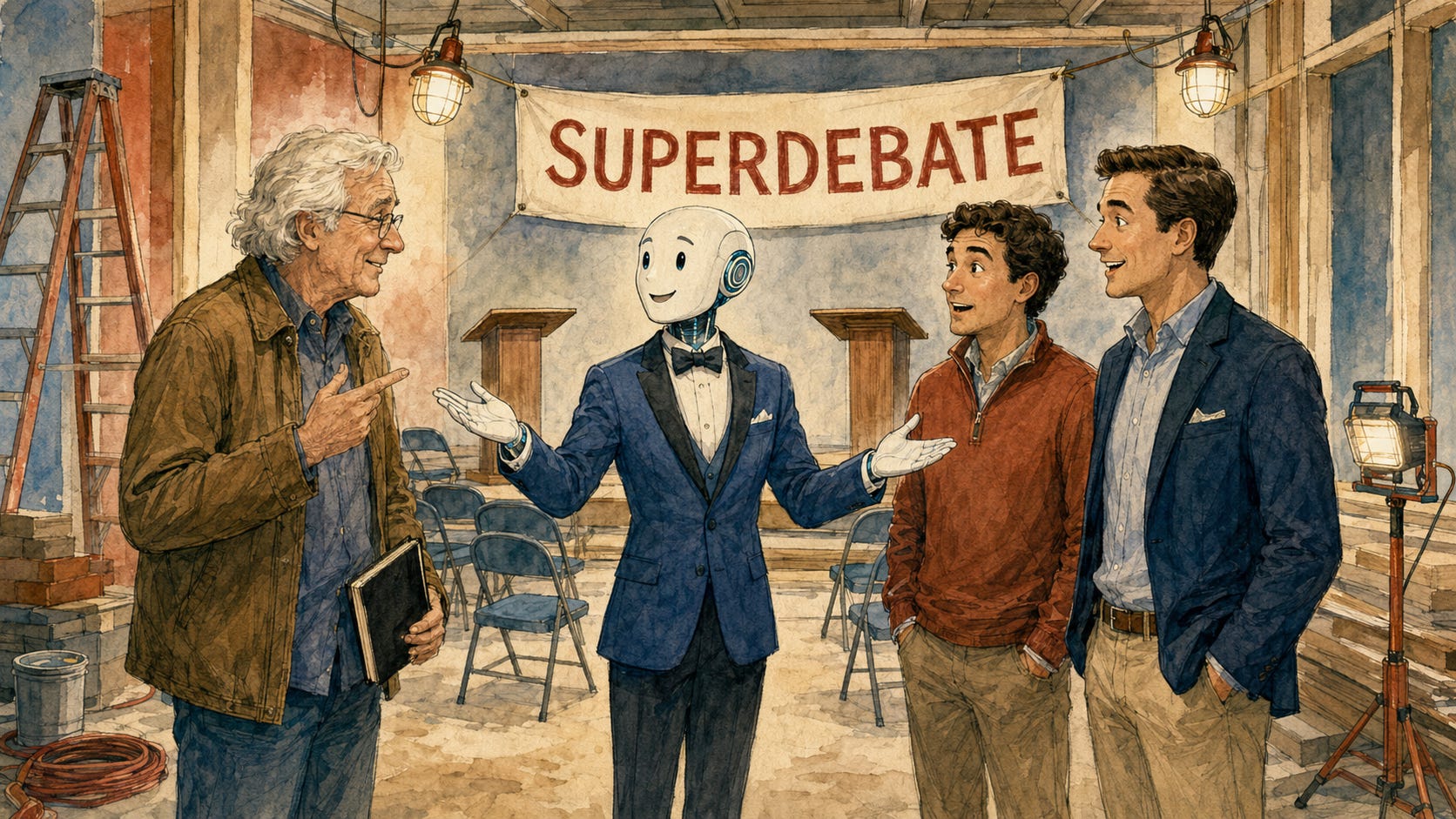
I recently spoke with John Connor and Matthew Rolnick of SuperDebate, a young platform attempting to build something that does not otherwise exist in any organized form: a competitive debate league for adults.
At one point, they asked how I had found them.
“ChatGPT referred me,” I said.
The answer seemed to surprise them.
It was true. I had asked ChatGPT about developments and opportunities related to online debate. Somewhere in that search, it found SuperDebate, a small operation that had not previously crossed my radar.
There is something pleasingly circular about an artificial intelligence introducing me to a debate organization that is itself experimenting with artificial intelligence.
Debate After Graduation
Most formal debate infrastructure is built for students. High schools and colleges have teams, coaches, tournaments and established formats. Adults who want to continue debating—or begin for the first time—generally have nowhere comparable to go.
There are excellent online communities, livestreams, podcasts and occasional events. There are also innumerable social-media arguments calling themselves debates. What is largely missing is a persistent adult league with clubs, scheduled competition, judging and accumulated records.
SuperDebate is trying to occupy that space.
Founder John Thomas Connor describes discovering policy debate as a teenager on Chicago’s South Side. Debate eventually took him to a city championship, a college scholarship and later work building technology companies and communities. His stated goal is to recreate the developmental benefits of competitive debate for adults who no longer have access to school-based programs. Connor’s account is worth reading.
According to its own press materials, SuperDebate has held more than a dozen live events, operates in four cities and has a community of more than 250 competitors and members, most of them associated with Chicago. Those are early numbers, but they represent actual debates rather than a presentation describing debates that might someday occur. SuperDebate press kit
A Debate Room in the Browser
The online system allows someone to create a live debate room without installing special software or assembling a collection of unrelated services.
A host selects the topic, format, side and speech length. The room provides synchronized timing for openings, cross-examination, rebuttals and closing statements. Debates can be one-on-one, team events or rotating relays. Audience members can watch and submit verdicts, while recorded debates remain available for later viewing and scoring.
The platform also permits 60-second recorded arguments. Participants can post a short case for or against a resolution, and others can answer with counterarguments without arranging a simultaneous meeting.
That asynchronous format may prove particularly useful. Finding someone willing to argue is not difficult. Finding the right person, on the right topic, at the same hour, with compatible equipment and enough uninterrupted time is considerably harder.
SuperDebate is therefore pursuing both scheduled debate and distributed debate: live confrontation when possible, recorded argument and response when it is not. Its online-debate system is described here.
The Contrarian
The feature that initially caught my attention was the AI Debate Coach.
Its opponent is called “The Contrarian.” It always takes the other side.
A participant can enter a resolution, select a side and choose a short practice round or a longer debate with openings, rebuttals and closings. The opponent’s strength can be adjusted, as can the turn clock and opening order. Participants may type or speak their arguments.
At the conclusion, the system produces a scorecard covering argument quality, refutation, delivery, organization, persuasiveness, and evidence and research. It identifies the participant’s strongest moment and selects one weakness to carry into the next session.
That last feature matters. Generic praise at the end of an AI conversation is nearly worthless. A useful coach must remember what the debater repeatedly does wrong and build later exercises around it.
The public roadmap goes further. SuperDebate describes future opponents with different argumentative styles, drills based upon arguments the user previously dropped, multiweek training programs and visual maps showing which claims were answered and which survived untouched.
That begins to look less like a chatbot with a timer and more like an actual debate gym.
The Moderation Question
My conversation with Connor and Rolnick became especially interesting when AI moderation arose.
An AI opponent is comparatively straightforward. It knows when its turn begins, generates an argument and evaluates the response according to a rubric.
Moderating two human beings is harder.
A useful moderator must distinguish persistence from repetition, clarification from evasion, and an interruption from an attempted correction. It must track burdens of proof, remember unanswered questions and enforce time without turning itself into a third debater.
It must also avoid deciding the controversy under the guise of managing it.
Consider the recent debate between Andrew Wilson and Dinesh D’Souza. Wilson repeatedly asked Dinesh to establish the moral “ought” connecting various reasons to favor Israel with a Christian obligation to support it. An AI moderator would need to recognize that the same unresolved question persisted through several historical and theological detours.
That does not require declaring Wilson correct. It requires understanding the structure of the clash.
SuperDebate does not publicly present a completed AI moderator for human debates. Connor and Rolnick appear to be exploring the problem. That alone makes the project worth watching.
Discovered by the Machine
I am not declaring SuperDebate the future of debate. It is small, early and attempting several difficult things simultaneously.
I am announcing that it exists.
It provides live adult debate infrastructure, asynchronous video responses, human judging and an AI practice opponent. More importantly, the people behind it appear interested in the same unresolved questions that interest me: Can AI do more than generate arguments? Can it identify what actually happened in a debate? Can it coach without flattering, judge without imposing its own politics and moderate without taking over?
There was also something revealing in their surprise at how I found them.
A small debate organization published its work on the open internet. An AI connected that work with the interests of someone who had never heard of it. That connection produced a human conversation that otherwise would not have occurred.
The machine did not replace networking.
It performed the introduction.